Wednesday, May 28, 2014

Armenia May 12


Some observations regarding Georgia vs Armenia.

They are both small Christian countries that were historically very much larger.  Both are surrounded by Moslem countries.  Armenia and Georgia were both under communist rule from 1921.  Over 600,000 Georgians and Armenians fought for the Red Army in WWII; over half died.  After 70 years of communist rule, both lacked capitalist talent or knowledge to switch to a market economy as compared to, say, China or Poland.  The dislocations they shared after "the collapse of the Soviet Union" are hard for us to contemplate: no pensions, salaries, jobs, electricity, heat -- almost no government. (And Armenia had an earthquake that took its nuclear reactor, half its power, offline).  The countryside largely emptied into the capitals or emigrated.  Both have received a large number of refugees in recent years.

Georgia is more inclusive, with a large Azeri community and several smaller minorities. There had been large numbers of Abkhazians and Ossetians. (They seceded after the collapse, with Russian help. The republics of South Ossetia and Abkhazia are recognized only by Nicaragua, Venezuela, and Cuba.)  Georgia claims, perhaps rightly, that there is no "documented" history of a significant ethnic discrimination.  Armenia is 98%+ Armenian. Azerbaijan and Armenia did complementary, post-Soviet ethnic cleansings.  Our local guide in Armenia assured us, repeatedly, "there are no Moslems in Armenia."  Armenia has had a diaspora for over a century; Georgia's is much smaller and lacks billionaires that make large investments.


It is the Armenian Apostolic Church. It is so designated as the first to bring Christianity to Armenia were Saints Bartholomew and Thaddeus, two of the apostles, the followers of Christ. In the late 3rd century, Saint Gregory the Illuminator was imprisoned for 13 years by the king for evangelizing. He was released when the king was sick and Saint Gregory's payers healed them. The king therefore declared Christianity the state religion in 301 and Gregory became the first head if the church, the Catholicos. To enforce the state religion, all pagan temples were destroyed and churches built on them. In addition, to make the new religion more palatable, some pagan ritual was incorporated. This included animal sacrifice which is still practiced today.


The Armenian church is not decorated.  (There are exceptions.)  It has few paintings.    It is, rather characterized by its architecture.   "There are two distinctive features of Armenian church architecture. The first is the use of double-intersecting arches to span the interior space, eliminating the need for the supporting columns familiar in other types of churches. In early Armenian churches, these arches were stone... The second feature is the pyramidal dome, supported by a drum, which is supported in turn by intersecting arches."  (
http://www.armenianchurch-ed.net/armenian-heritage/architecture/).  Armenian monasteries get their grandeur from their sites-in mountains, caves, isolated, magnificent.

The major decorative item is the khatchkar, the stone cross.  It is a bas relief of a "blooming" cross.  No two should be alike.  Even if they are together as part of a decorative scheme, they will be different in detail.  The cross can be carved on a structure, such as a church wall, or free-standing. The free-standing khatchkar is still a bas relief, but is a free-standing slab.  The khatchkars are also used as tombstones and monuments.


Another  "decorative" item in the churches is inscriptions.  Written on the walls are inscriptions telling who built the church when , who renovated it when, who funded the renovations.  These include recent donations.  We are told that even if it is 500 years, theses people are still remembered in the prayers.  Also people scratch khatchkars into church wall in thanksgiving or prayer.

***

We are staying at the Yerevan Marriott, which is in a renovated Soviet era building.  We have a very plush room and a great breakfast buffet and outrageous laundry costs.

After Gocha lectured on ancient colonization of the Caucasus, we proceeded to the Armenian Genocide Memorial.


    The removal of 2 million Armenians from their homeland in NE Turkey was accompanied by an estimated 1 to 1.5 million deaths.  The entire episode lasted decades, but the most massive deaths occurred in 1915.  The term "genocide" means an intentional program of extermination and it was first used in the context of the Armenian genocide.  Turkey denies the characterization (but admits to massacre) and refers to wartime conditions when Russia was fomenting an Armenian rebellion.  It is a crime in Turkey to use the term "genocide."  The last journalist to make the assertion in Turkey was assassinated.  Obsessive efforts to keep the memory of genocide alive is to a considerable extent a defining character of Armenia today.

      Next we visit the large, local market.  The pickled vegetable booth:


Fruit:


Remnants of the Soviet era include old Lada cars (sort of like the American cars they keep going in Cuba) and very big buildings.  


After lunch, we go to the Monastery complex at Geghard.   It is located at the end of a dramatic gorge.   


Our last stop was the Hellenistic Temple, which was downstream a few kilometers at Garni.  


An inscription states that it was erected in 77 AD.

 It stood fairly intact until the 17th century.  The base was fastened with lead-lined iron pins.   After guns were introduced into the area, the local residents chipped the stone away to scavenge the lead for bullets.   


At the next big earthquake, the structure fell down.   In 1962, the Temple was restored.  It is beautifully proportioned, as one would expect.  The use of basalt (marble supply somewhat limited) and it's situation at the edge of a cliff render the setting inspiring.  The experience was a bit marred, however, by the broadcast of duduk music and some questionable restoration choices (a barrel vault?).

We had dinner by ourselves at the Ararat restaurant.  Grape leaves, blini, excellent local wine and brandy.  


Tuesday, May 20, 2014

Georgia 3


Saturday May 10

Long ride to Gareja Monastery.  St David (not David the Builder) was a Syrian monk of the 6th century who came to Tbilisi to instruct the Georgians.  He, with two others, left Tbilisi and went to live in a cave.  Eventually, the caves became a monastery and they carved many rooms from the stone. It continues as a monastery. By the 13th Century, there were 14 monasteries in the area.  On Easter, in 1615, we are told that the 600 monks were celebrating, each with a candle. The Persians, on the other side of the mountain, saw the light, came to investigate, rounded up the monks and beheaded them.  The monastery was attacked many times and always repopulated.  The communist regime used the monastery's territory as a training ground for their Afghanistan war and there was some damage to the murals during that time.  It is an active monastery today so major parts are off limits to tourists.


On the way to the monastery, we saw mixed flocks (herds?) of sheep, goats, and cattle being herded to their summer pasture in the mountains.  The herders were on foot and horseback with their supplies packed on donkeys.  They were accompanied by dogs, but we did not notice them actively herding.  Theses are professional herders who take up the animals of local farmers.


Tonight was the celebratory leaving Georgia meal.  It was led in Georgian style by a toastmaster (tamada) and a quartet sang Georgian songs to match the toasts.  The style is polyphonic.  We had the usual tomato cuke  salad, chicken salad, three cheeses, three walnut and greens dishes, meat stuffed grape leaves, chicken in garlic sauce, beef and pork kebabs and mixed fruit.  We are hoping that the leftovers make it to the poor.


A note on Georgian churches.

The Soviets closed most of the churches, repurposing them.  With the collapse, the churches were cleaned up, priests came out of the woodwork and worship was revitalized.  The churches are attended, respect is shown, headscarves are worn.  As an Orthodox church, it has an iconostasis, a screen in front of the altar, blocking the view of the congregation.  It is full of icons which are revered and kissed by the worshippers.  There are few seats.  Congregants stand around the edges.   

A note on Georgian history.
We have presented historical matters as they were related to us.  Much is based on unverified legend.  Georgia is in a perilous situation.  For Georgians, history is a potent tool in a zero-sum game.  The narrative is still being composed and is far from complete.  It has been  interesting watching this history being developed.


Sunday, May 18, 2014

Georgia 2


Wednesday May 7

We started with the Begrati Church in Kutaisi, part of which dates back to the 4th century:


This church was designated a UNESCO world heritage site.  It lost this designation because of the restoration effort, which included the glass wing you see on the left.   (The wing was for an elevator that was never built.)

Next we saw the Gelati Monastery, dated 1106, and known for its frescoes:


Leaving Kutaisi, we passed this whimsical fountain:


All of the animals are giant-size copies of ancient items now in the Tbilisi museum.


After lunch, we visited Vani, a huge archaeological site in the ancient area of Colchis.  The stratification of cultural deposits goes down several meters.


Most of the structures were made of wood, which does not survive. This cult altar is the most impressive remain:


Vani was established in the 8th century BCE.  It was destroyed by invaders around in the first century BCE.  The archaeologists have not figured out who did this, or why.  The area was resettled and later abandoned, circa 150 AD.

We visited the former museum.  As noted above, the regional museums in Georgia have been emptied out.  The best artifacts are in the Tbilisi History Museum.  The rest are kept in storage.  This museum is a repository for this site.


The man above was our archaeological expert, Gocha Tsetskladze.

We stayed at the Bakuriani Ski resort built by German interests circa 2006-07.

Lunch:  eggplant with walnut sauce, beans with walnut sauce, salad, bean stuffed bread, veal shish kebab, and more.  Cannot remember dinner.


Thursday, May 8

We had a long ride through the Georgian countryside, which provides a suitable place to comment about the Georgian economy.  Georgia currently has no relations with Russia, which has occupied about 20% of its territory, Abkhazia and S. Ossetia.  Also, unlike Armenia, Georgia had no history of massive emigration prior to the collapse, so remittances from workers abroad are just beginning to have an impact.  Many people who once had Russian educations and socialist-type jobs now find the factories closed and their skills unneeded.  Altogether, Georgia's population, which peaked close to 6 million, now stands at 4.5 million.


The towns outside Tbilisi have knots of unemployed and a truly vast amount of empty, decaying structures.


We pass Atskuri, a fort.


Our major destination was the Vardsia cave monastery complex:


Tamara (1184-1213) ascended the throne at the age of about 16.  She was the sole ruler for many years.  She led her troops into battle.  For these reasons she is known as "king Tamara".  She reigned over the golden age of the Georgian kingdom and was responsible for many buildings.  This monastery was started by her father and continued by her.  For her activities, she was sainted by the Georgian Church.  (It is a feature of the Georgian church that it has "secular saints." It is not their contributions to religion, but to the state for which they were sainted. King Tamara and David the Builder are examples).

Lunch.  Vadias  home made wine, trout from river, khatchpuri with homemade cheese

Virtually every meal includes khatchpuri. It is a bread stuffed with cheese. It looks a bit like a large pita. We find that the quality of the dish relates to the cheese used; the bread part is usually quite good.  

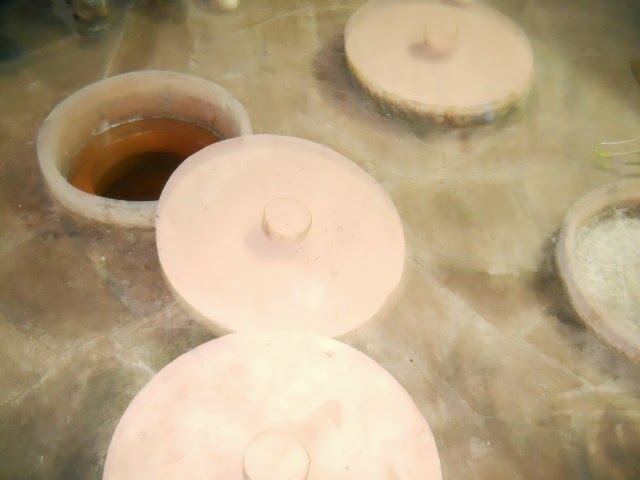
Anyone with a few square meters plants grapes.  And in the basement, large terracotta pots are sunk into the ground.


These pots are where the wine is fermented.  It is transferred to other pots to rid it of sediment.  We were at least twice treated to homemade wine. We enjoyed it very much.

Late return.  Unremarkable dinner.

The Georgians are very proud of their water. They have scads of lakes and rivers. All their power is hydroelectric.  They are starting to export power. We went to Borjomi, which has famous "curative" water.  We have been drinking the tap water.


Friday May 9

We started a with the cave city of Uplistsihke, which had been cut out of the rock.  The site was occupied from the early bronze to around 1500.  It declined as the Silk Road was supplanted by the newly discovered ocean routes.   

The site is very dramatic, but not made convenient for visitors - parts with no railings, using grooves in the rock as paths.  Leslie was given a minder who showed her the best way and he helped immensely.  The site requires a local guide.  When we were done, our archaeology expert explained her errors.


There was a new museum at the site.  The modest collection of ceramic pots and early iron nails was nicely displayed.  Thee were pictures of the really good stuff as it is sent to Tbilisi.

The khatchapuri at lunch was a new one, Ossetian, with potatoes and an unfamiliar cheese.  Smoked fish salad.  Ground beef kebabs.   Lots of fruits.

We stopped at the Stalin Museum in Gori.  This substantial structure was built around the site of his one-room birthplace.


The museum is grand.


The gift store:


Today was Victory Day.  Veterans of WWII are celebrated.  Georgia and Armenia each contributed hundreds of thousands of troops to defeat the Nazis. About half were lost.


Finally, we stopped at Svetitskhoveli (1010-29).  It is famed for the tomb of Sidonia. Sidonia, the only Jewish woman buried in an Orthodox Church, was given the robe of the crucified Jesus and she died from the emotional trauma of holding it.  The mourners could not pry the robe from her grasp, even in death, so she was buried with the robe.  A cedar tree was planted on her grave.  Centuries later, in Georgia, the first Christians began to build a church, using the wood from the tree.  When one of the beams began to glow, the building site became a pilgrimage destination.  This is the icon of Sidonia.


While we were there, the clergy had a ceremony to celebrate the movement of an icon traveling to another church.  


The procession was accompanied by a vigorous ringing from the bell tower.


The icon was on a visit from the US and is doing a tour of Georgian churches before going home.

Saturday, May 17, 2014

Georgia 1

Georgia Sunday May 4

Tbilisi 

We started our visit to Georgia at the recently-completed Holy trinity Cathedral...

...where we heard part of the liturgy which is responsive between the priest and a polyphonic choir.
Then we went to the History museum, which contained pre-Christian artifacts, mainly gold.  Jason came to Georgia to get the golden fleece because gold mining and smithing is very old here.  

Bruce visited the upstairs Museum of the Soviet Occupation.  It portrays, through photos and documents, the incredibly savage and destructive Communist regime.  It's a fairly compact presentation.  It did not mention how other communist places were treated, nor did it fully explore the extent that home-grown Marxism.  The Soviet Army was apparently welcomed when it arrived in 1921. We understand that the church here was not persecuted, but there was certainly a red terror here, with liquidations of the elites, the gulag, etc., and this is pretty well documented in the Museum.

Leslie went to the cloisonné technique reconstruction.  The technique was lost for many years.  Like so many crafts around the world, it is being revived.  The film (really a slide show with no text) showed how the tools for process were reconstructed and then the revived technique.  It is called cloisonné her but there is no wire.  Some of the enamel is cut to shape and the background is brushed on.  We later saw beautiful examples of the modern craft.


We then went on a walk to see views of the city.

  Some of the newer buildings have novel architectures:

"House of Justice" (for recording deeds and getting drivering licenses):


Theater and Modern Art Gallery:


  We had to walk down some 300-400 meters. The funicular was not working.  At the bottom, we arrived at the old quarter.


Lunch was a large spread:  salads, chicken salad, cheese stuffed bread (a Georgian specialty), stewed mushrooms, veal stew, pork shashlik, wonderful bread.

Then on to the Fine arts museum.   More ancient gold, including this goblet dated back to the 17th century BCE:

 There were also many Christian artifacts, including a remarkable collection of icons and crowns. Interestingly, there are some gifts from the Patriarch to the icons in some of the cases.   Copies of one of the icons sat in the case next to the original to pick up the sanctity. They will then be sent to churches.  More copies will be made.

Old town walk.  The old Synagogue is in ruins and under restoration.


The new synagogue is unlike what we would expect.  


Interestingly, the principal Jewish funder for the new synagogue was also a major contributor to the Holy Trinity constructions.

Which leads to a comment about Jews in Georgia, based on what we were told.  The community is said to date back to the destruction of the first temple and indications are that Jews have been welcome here.  After the collapse of the Soviet Union, about half of the Jews left, not because of discrimination, but due to economic conditions.  Most went to Israel, and many of those kept their property and return to Georgia during the summer months.  There are direct flights to Tel Aviv daily.  Our local guide said she sometimes thinks that half of the tourists now are Israeli.


We then went to Sioni (Zion church, a common name, dedicated to the Assumption).  It was the cathedral before Trinity.  Every cathedral has a seat reserved for the Patriarch, when he visit.


The Georgians take their church very seriously. It is the Georgian Orthodox Church. The Patriarch, "Catholicos"' is seated at Trinity.  The Georgian Church has been independent from the beginning, except for a time in the 18-19th when it was subject to the Russian Patriarch.

Welcome dinner with wine:  walnut stuffed vegetable, chicken salad, cheese pasta packets, cheese stuffed bread, pork potato stew, chicken shashlik and more.  No dessert.  Quite a day.


Monday May 5

Long bus trip toward SE.  We went to Dmanisi, where earliest homo erectus remain where found outside of Africa, around 1.7 - 1.8 million years old.


 We then sat in a grassy field for a lecture by our Georgian archaeologist host.  We learned that archaeology in Georgia under the Soviet regime was very well funded.  But since then, archaeology has all but ceased; worse, it is being conducted by amateurs.  All of the regional museums have closed and the artifacts have been sent to Tbilisi.  He spent some time praising the Georgian character.  He said that whenever a Georgian farmer finds something, he turns it over to the State.  Hard to believe, but there doesn't seem to be a black market for Georgian antiquities.

After a picnic (salad with ham and cheese, chicken sandwich), we went to the Bolnisi Sioni Church, which has the oldest Georgian inscription, going back to 493 AD.


  Unfortunately, our guide was not able to find someone with the key , so we did not see the interior.  

We stopped at a silk batik cooperative.  This was I unscheduled, but we had extra time because of the truncated church visit.  The studio facility was an interesting glass enclosure, but we were not interested in the product.

Both of use are sick now, so we skipped dinner and stayed in.  (Better now).


Tuesday May 6


Tbilisi to Kutaisi.  A lot of walking on steep surfaces. 


 Next, we went to the old church above Mtskheta (sic).  The church contains an important icon of St Nino.


  It was she who brought Christianity to Georgia.  There's a myth of curing the queen and guiding the lost king.  What is interesting is her cross.  She made it of vine stems tied with her hair.  As a result the arms of St. Nino's cross droop.  We were told they converted from Zoroastrianism.

The church had a constant stream of visitors, including a man who dragged an unhappy ram on a leash. 

We climbed to a Roman site, Bagineti.  The extraordinary grave goods are in history museum Tbilisi. The site includes two bath houses (one with a large mosaic), cistern, pithoi, and a six-column audience hall in an unusual shape:


Next was the cemetery in the Samtavro Valley, where archaeologists found over 4000 graves dating over a 3000-year period.  All were welcome -- Christian, Jewish, Muslim, pagan graves.  The first Aramaic inscription is from the 3rd  century BCE, the time of the first Jewish migration to Georgia, before the destruction of the 2nd temple.  The Jewish population is thought to have been 7000.

We enjoyed a great lunch.  Walnut stuffed eggplant, ground meat skewer, meat dumplings with juice, PIC 

 and cheesy bread. 

Dinner included eggplant with walnut sauce, fried chicken , ground meat skewer, stew.