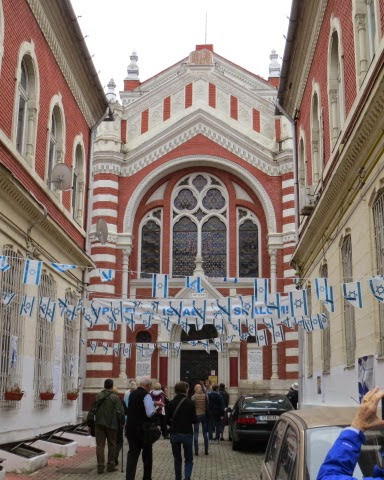
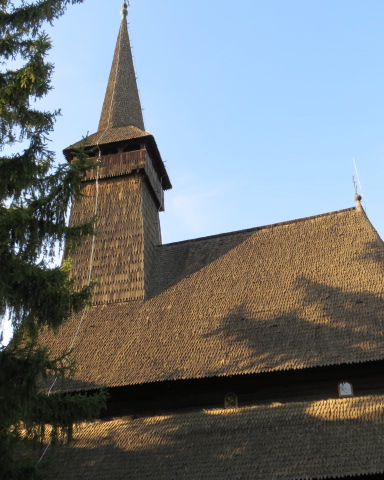
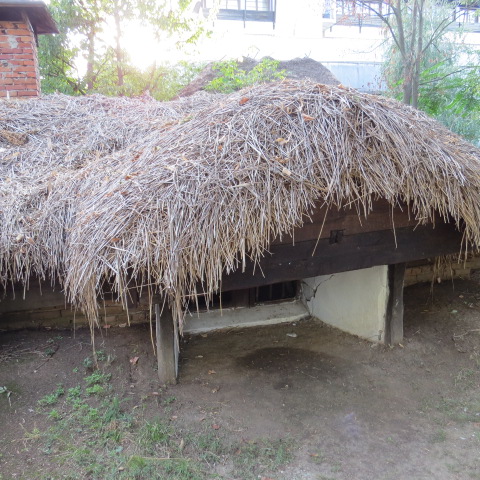
we learned today that there are Muslim communities in eastern Romania.
Wed Oct 3.
Long day of driving from Braslov to Gula Humorului.
Variable mountain scenery, from pastoral to rugged.
We go through the Hungarian part of Romania. Catholic. New language:

We visit a church , which is the site of a miraculous statue.

OMG:

Lunch is fresh trout and Moldovian red & white house wines.
Dramatic gorge:

On the North side of mountains, we return to the Orthodox/Romanian sections.
We arer staying 2 nights at Buna Humorolui, a small town near the famous painted monasteries. Our huge, exceptionally ugly, Best Western dominates the scene.

****
October 4. Painted Monasteries.
In Bukovina, NE Romania. This is a very poor area. Many households keep chickens in the yard. Horses are still used for transport. The red tassles ward off the evil eye:

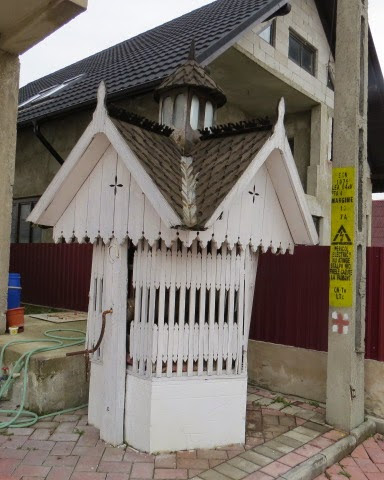
Some corn is apparently grown and harvested by hand. Outside of town, water is drawn by well. The wells are capped by a little structure, e.g.:
Still, there is a lot of new home construction scattered about. The countryside (flowing meadows and fields and gently woodsy mountains) is far from deserted.
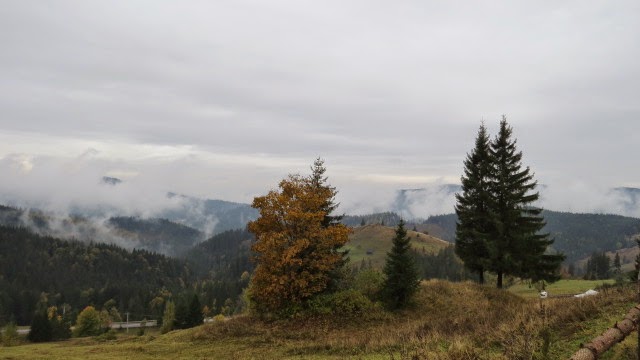
Today we had the treat of visiting four painted monasteries.
These monasteries were forts with serious walls around them.

These monasteries are painted inside and out. With one exception, only the south side of the exteriors survives. They are from the 15th and 16th centuries.
The nature of iconography of then Orthodox Church is that it is basically the same on all churches.
Looking at the south wall, on the right or east or the apsidal side is registers of saints.

In some manner are interspersed cherubs.

In the middle is a Jesse tree, the family tree of Jesus.

To the left is a hymn to Mary


The entry on the west side has a last judgment. The Orthodox Church has not been influenced by Dante. Under a representation of God the father, Jesus, and the dove of the Holy Spirit, there is shown the contest of an angel and a devil for the soul. Those going to hell are consigned to the fiery river that emanates from the foot of Jesus. At the foot of the river is the Leviathan from Revelation.


One of the churches had a north wall surviving. It shows Jacob's ladder, with people going up.
Angels are helping those going up and devils are pushing them down.

Inside, (alas, no photos allowed) the pronaos, the first room, is dedicated to Holy Mary and is as far as women were allowed (except for communion). There the walls are decorated with the calendar of saints' days. The dome has a picture of Mary.
There may or may not be a second room where the donors to the church are buried and there is a secret room perhaps to hide, perhaps for treasure.
The main room is the naos. (Naos is the same word as nave.) There are found pictures of the Passion and life of Christ. The lower registers show the military saints and the donor (and, usually, his family). The dome has Christ Pancrator.
We visited Veronet, painted in the 1540s. It was donated by King Stephen. The portrait is believed to be contemporaneous and an accurate depiction.
The next monastery was Moldovita (1537??) .It was interesting in that it include philosophers, Socrates, Plato, and Aristotle among the saints.
We then went to Sucevita This is from the late 16th century. The walls are intact and very much a fort.
The pronaos is not dedicated to Mary. She is in the burial chamber.
Also depicted are scenes from Exodus.
The naos is dedicated to the resurrection.
A note on color. It the scene is of this world, the sky background is blue. If it is of heaven, it is white.
The last monastery was Humor. It had no domes as it's donor was not royal. The dedicatory panel in the naos showed the prince offered the church, as it was on his watch, but in the burial chamber was another offering picture of the actual donor, a high official.
Also there is also the dinner where Abraham and Sarah entertain the angels. We are told this is when Sarai is tools she will conceive. Is ith then?
Voronet, the oldest, was built and decorated in the 15th Century. The last judgement scene destines these Turks for hell:

These Christians are heading up:

We were told this panel depicts Jonah:

Jewish cemetary. During the 19th Century, the Hapsburg Empire settled a lot of different groups here, including German and Jews. Before WWII, there were about 1000 families each of Germans and Jews and 3000 Romanian families. There is a large Jewlish cemetary with some tombstones erected quite recently. There are no longer any Jews here and there is a concern about ongoing maintenance.


Lunch -- Local soup sour cream, vinagar, potatoes, chicken. Peach with currant preserves. Salad.
Dinner -- Moldovian meatballs, mushroom
*****
Sunday, Oct. 5. Another long bus ride.
We leave Gura Humorului for Cluj. This is the part of Romania with a large population of ethnic Hungarians, referred to as Hungarians.. Our tour leader and his assistant are of this group; the bus driver isfrom Hungary.
We stop Bistrita for lunch and walk around. This was a German town. It was thriving in the 15th Century and it retains an Austrian feeling:

From the church bell tower:

There is a 16th Century Lutheran church.

The town was celebrating Octoberfest.
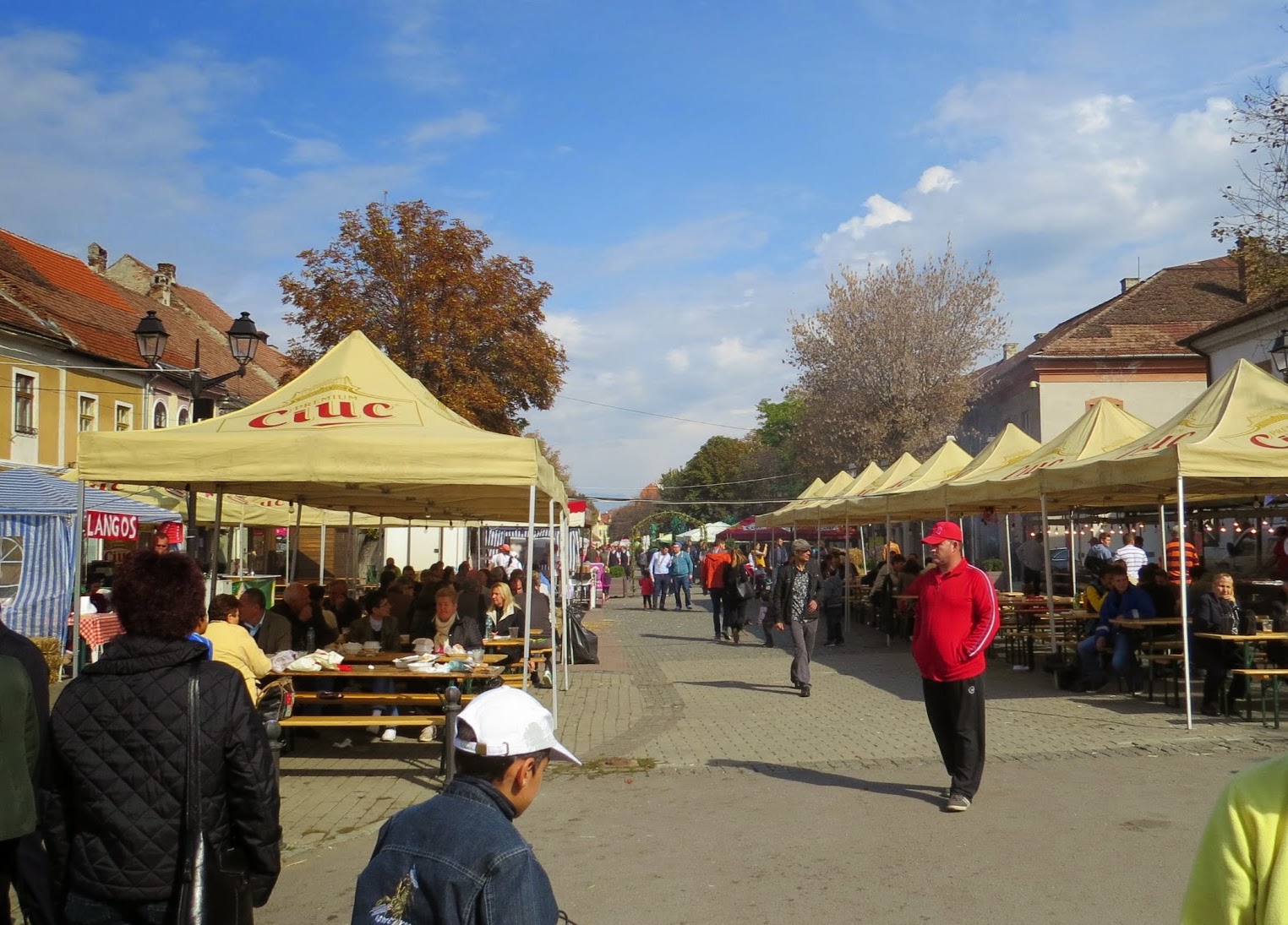
Lunch was insipid chicken. We wish they had taken us here:

This is a cozonac maker. A delicious snack:

We proceed to the Bánffy Castle, near the village of Bontida, a Hungarian estate that has been held by the same family since the 13th Century. The current buildings went up in the 18th Century. The Nazis used it as a hospital and torched it on the way out. The walls are very thick and the structures survived the fire. But the ruins were used as a quarry during the communist period. In the 1990s it was listed as one of the world's most endangered sites.
After the owner was able to recover possession, he leased it to the Transylvania Foundation for 49 years. The Foundation put roofs on the buildings and otherwise stabilized the structure. It is used today as a restoration school. About 50 students live there and learn restoration skills each summer. Students from 32 countries have attended.


Bland dinner at hotel. OK bruscette, chicken paprikash and polenta, cream brule.
We are told that we use hotel restaurants because our colleagues are afraid to use local restaurants. BS.
*****
Monday, Oct. 6
First stop, the salt mine outside of Turda, a nearby town. There is evidence of the Romans mining salt here. The mine we visited dates back to the 18th Century. Most of the asctivity was in the 19th Century. The mine closed in 1932 for business reasons. It was reopened as a tourist attraction in the 1990s with major improvements circa 2009.
Outside, there were flat areas where the salt had leached to the surface. The purple salt plant grew there.

The salt was deposited in striations reflecting cycles of rain and drying:

This area was the last to be mined:

The rest of the day reflected our leader's interest in building restoration and his Unitarian church activities in the village of Rimetea (or, in Hungarian, Torocko).
We had an excellent lunch (tarragon chicken soup, pork in hunter's sauce, walnut pastry) at a local pension.
 We were treated to a local wine tasting. We had these with the food:

We then walked around the village and had the restorations explained:

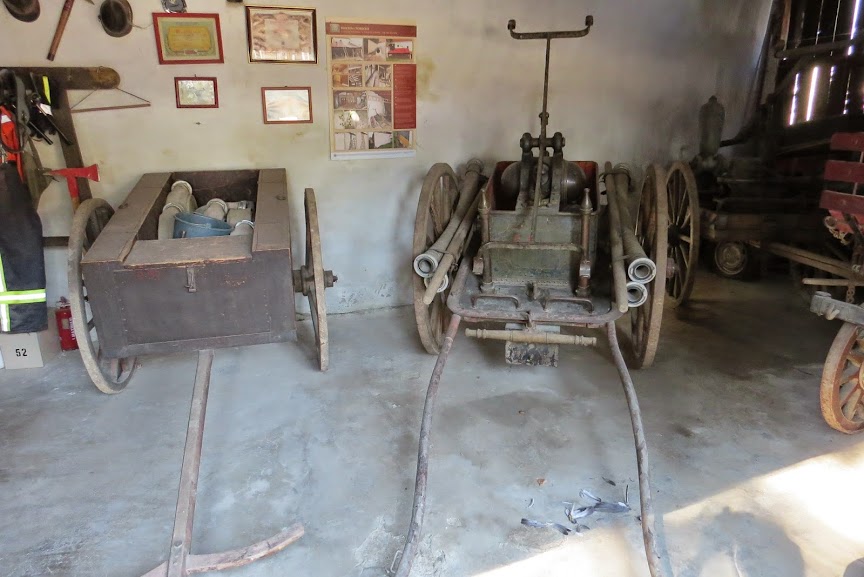
This fire equipment was still in use, we were told:
Unlike the other areas of Romania was had visited, the valley was quite dry. The forest was cut down to produce charcoal for an iron industry and this probably contributed to the micro climate. Great for the wine.
We had dinner (cheeses, meats, salad) at a dormitory, run by a church foundation, for girl students attending high school from out of town. Our dinner companion was Sixtene, a 21-year old design student in her final year. She was responsible for after-hours access to the small building and, in return, got room and board.
Sunday, Oct. 5. Another long bus ride.
We leave Gura Humorului for Cluj. This is the part of Romania with a large population of ethnic Hungarians, referred to as Hungarians.. Our tour leader and his assistant are of this group; the bus driver isfrom Hungary.
We stop Bistrita for lunch and walk around. This was a German town. It was thriving in the 15th Century and it retains an Austrian feeling:
From the church bell tower:
There is a 16th Century Lutheran church.
The town was celebrating Octoberfest.
Lunch was insipid chicken. We wish they had taken us here:
This is a cozonac maker. A delicious snack:
We proceed to the Bánffy Castle, near the village of Bontida, a Hungarian estate that has been held by the same family since the 13th Century. The current buildings went up in the 18th Century. The Nazis used it as a hospital and torched it on the way out. The walls are very thick and the structures survived the fire. But the ruins were used as a quarry during the communist period. In the 1990s it was listed as one of the world's most endangered sites.
After the owner was able to recover possession, he leased it to the Transylvania Foundation for 49 years. The Foundation put roofs on the buildings and otherwise stabilized the structure. It is used today as a restoration school. About 50 students live there and learn restoration skills each summer. Students from 32 countries have attended.
Bland dinner at hotel. OK bruscette, chicken paprikash and polenta, cream brule.
We are told that we use hotel restaurants because our colleagues are afraid to use local restaurants. BS.
*****
Monday, Oct. 6
First stop, the salt mine outside of Turda, a nearby town. There is evidence of the Romans mining salt here. The mine we visited dates back to the 18th Century. Most of the asctivity was in the 19th Century. The mine closed in 1932 for business reasons. It was reopened as a tourist attraction in the 1990s with major improvements circa 2009.
Outside, there were flat areas where the salt had leached to the surface. The purple salt plant grew there.
The salt was deposited in striations reflecting cycles of rain and drying:
This area was the last to be mined:
The rest of the day reflected our leader's interest in building restoration and his Unitarian church activities in the village of Rimetea (or, in Hungarian, Torocko).
We had an excellent lunch (tarragon chicken soup, pork in hunter's sauce, walnut pastry) at a local pension.
We then walked around the village and had the restorations explained:
This fire equipment was still in use, we were told:
Unlike the other areas of Romania was had visited, the valley was quite dry. The forest was cut down to produce charcoal for an iron industry and this probably contributed to the micro climate. Great for the wine.
We had dinner (cheeses, meats, salad) at a dormitory, run by a church foundation, for girl students attending high school from out of town. Our dinner companion was Sixtene, a 21-year old design student in her final year. She was responsible for after-hours access to the small building and, in return, got room and board.