Saturday, August 9, 2014

Venice Aug 7-9.

Thursday, August 7.  


A clear, very warm day, desite high rain probabilities.


7-day vaporetto tickets went up to 60 euros from 50 last week.


The Ca’D’oro, regarded as the most beautiful of the surviving Renaissance palaces that line the Grand Canal, is now a museum (what else?).  During the 19th century,  owner Baron Giorgio Franchetti assembled a personal art collection, mostly by acquiring works from decommissioned churches and monasteries at distressed prices.  


(We don’t really have a handle on the historic details.  The Museum placards here and elsewhere explain that under both the French and the Austrians, many churches, monasteries, and convents were closed.  A lot of art has been lost to bad maintenance, but a lot found its way to the art market.  Cf. the Henry Horn Museum in Florence.


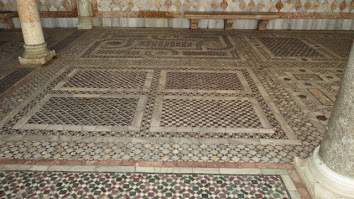
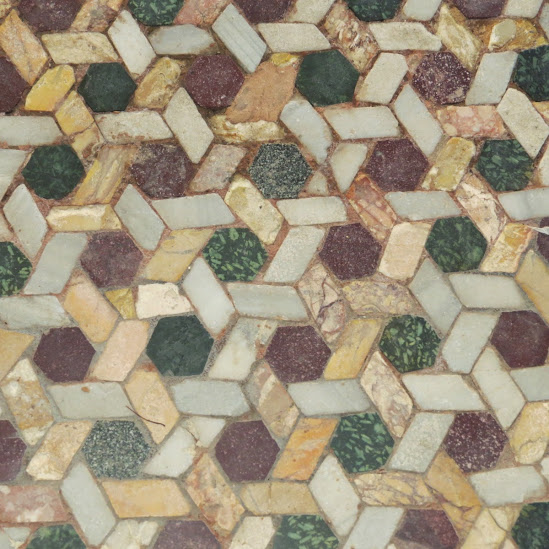
We started with the exterior stone floor, installed by Franchetti in the 19th Century.  The designs were inspired by church floors of San Marco and SS Maria and Donato in Murano (see Friday).


Franchetti used marbles sourced from around the Mediterranean.  


Photo


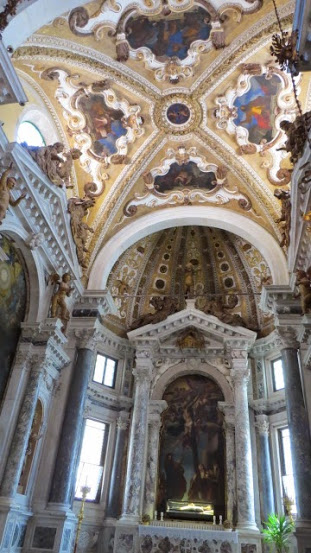
Upstairs, Andrea Montegna’s St. Sebastian was clearly the star of the show:
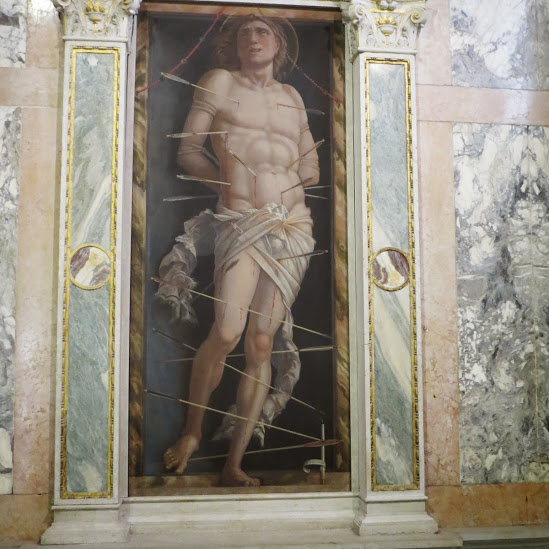


Franchetti created a small chapel to house the work:


(Montegna St. Sebastian’s are also at the Louvre and the Vienna Kunsthistorische.  But Montegna is probably best known for this riveting foreshortened image of Christ:


)
We interrupted our visit to the Ca’D’Oro to visit several churches in the district, but first we went to lunch.


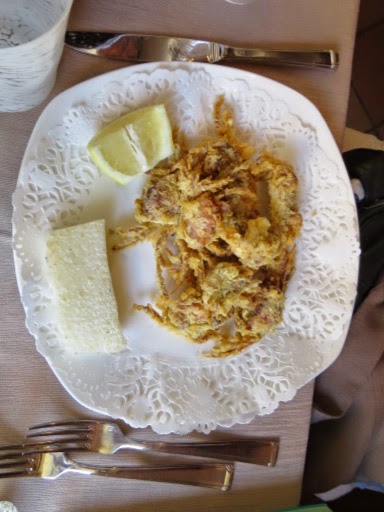
We chanced upon Vini di Gigio, an attractive and highly-rated restaurant.  Leslie ordered the soft-shelled crabs.  They are very small (spider crabs) and delicious:


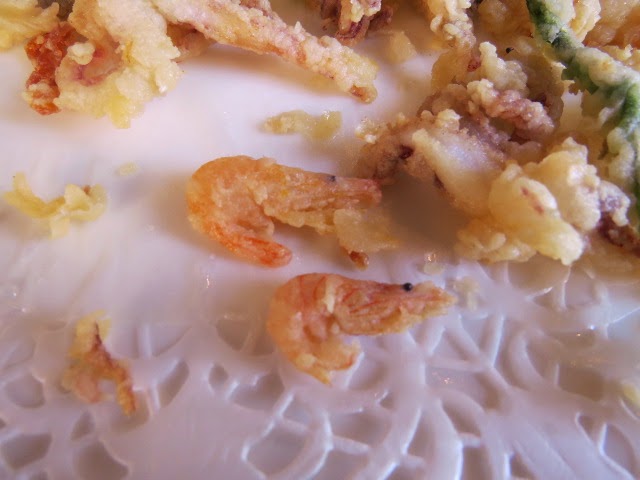
Bruce had frito misto again.   There were some of the smallest shrimp ever fried:


One church was that of St. Alvise.  St Alvise is St Louis of Toulouse.  This St Louis was the son of Charles II of Anjou for whom he spent 7 years of his childhood as a hostage.  He became a Franciscan and bishop of Toulouse.  It is not clear why he was canonized in 1317.


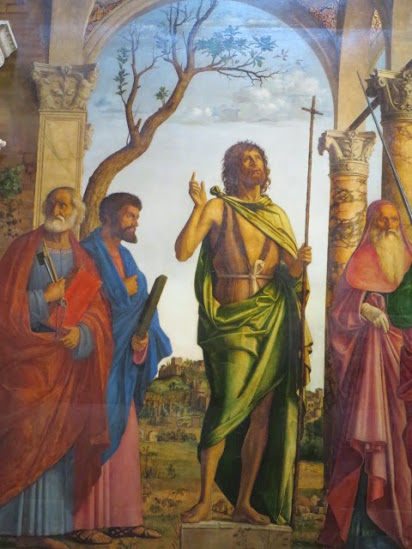
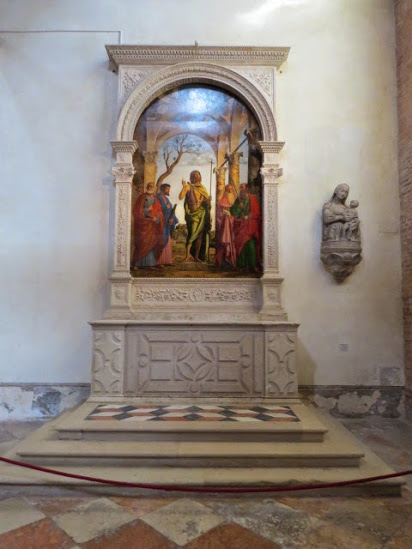
Bruce was especially taken with this saintly grouping by Conegliano.


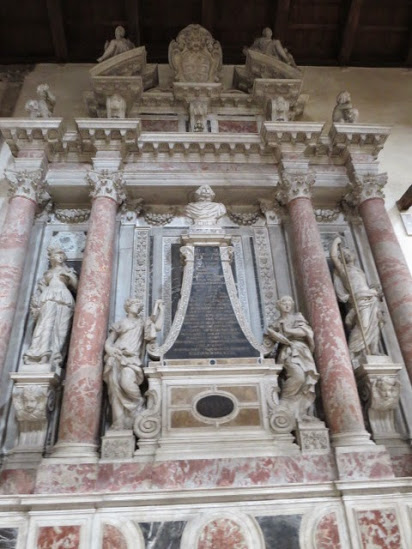
Tintoretto’s tomb:


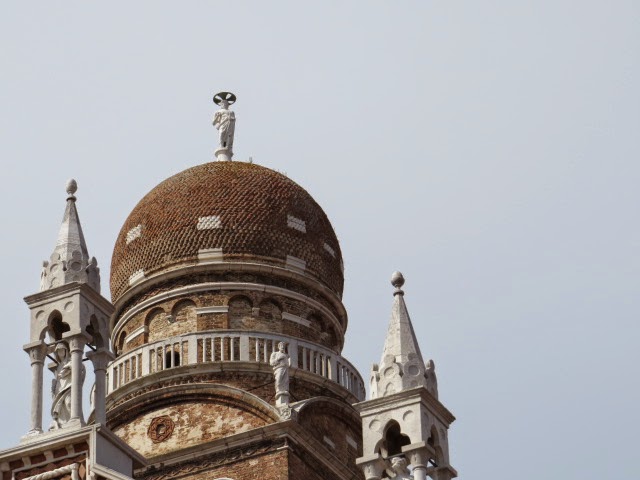
Santa Maria del Orto has interesting exterior features:


Photo


Inside there were many Tinteretto’s.


The church was built to house this miraculous statue:


Friday, August 8.  Murano.


Murano is about a kilometer north of Venice.  Although it was settled earlier, it does not have the space for a large town to develop.  In the 16th Century, the Venetian Council ordered the glass industry to re-locate all facilities to Murano.  The idea was to protect trade secrets.


The strategy could not fully succeed and, by the later 17th century, there were competing glass centers in France, Prague, and Augsburg.  Venice’s glass works today have held on by a thread and there seems to be something of a resurgence.  We are informed that there are 8 furnaces at work and about 5000-7000 residents on Murano today.


Mostly the stuff is crap:


But there are some new and imaginative products:


Murano’s best site is the Church of SS Maria & Donato, famous for its 12th century floors:
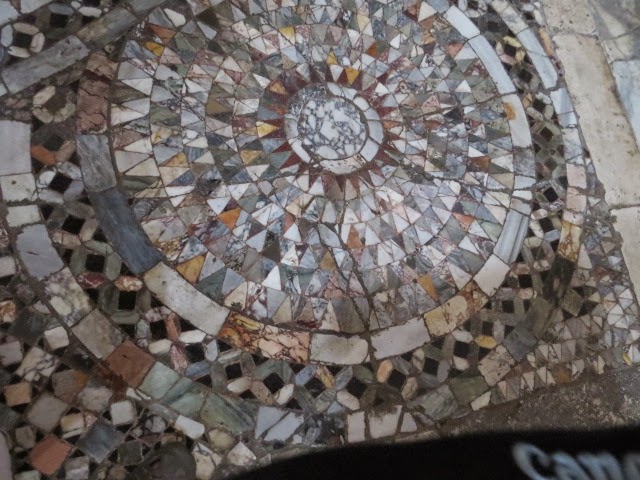


What is this?  Lice?
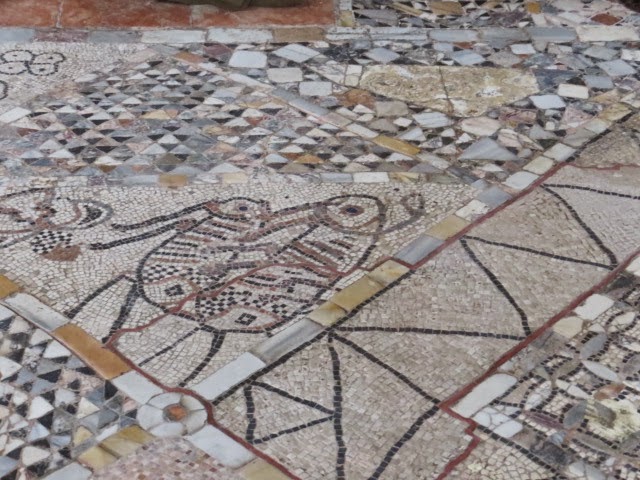


The central square hs been enlived with this large work:


We had lunch at Busa alla Torre (awnings in the background).  More soft-shelled crabs (larger); Leslie had fried scampi.  


We went to dinner in San Stefano square down the street at Ristorante San Stefano:  gnocchi with tomato cream sauce with ham;  lasagne (cold cream was poured over it and the sauce was seasoned with cinnamon) --- both quite good;  sgroppino.  We had fond memories of sgroppino from Bellagio.  There it was lemon ice with prosecco and vodka poured over it.  Here it was a drink of lemon gelato and, I assume, prosecco and vodka run through a blender.  It was too sweet and, of course, lacked the texture.


Saturday, August 9:


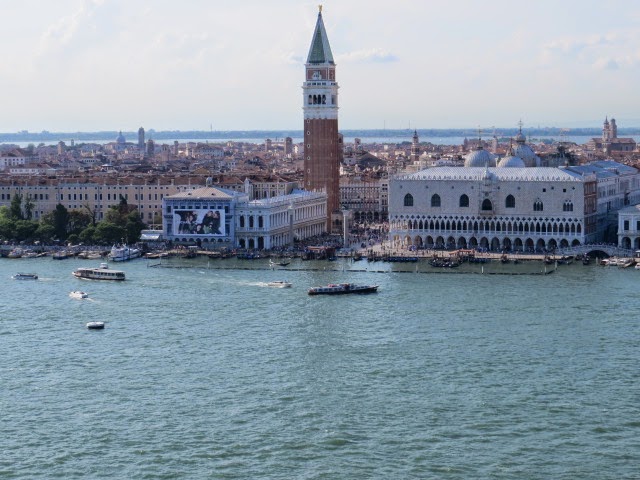
We woke up earlyish so we decided to go to the Palazzo Ducale and beat the lines.  Its the pinkish building on the right:


All of the high government offices were here.  It’s also where the Doge and his family lived.  And, next door, you find the prison.  Many volumes have been written about the government of Venice, which lasted over 1000 years.  Here, we’ll spend less time than we took to describe a disappointing sgropinno.


The government of Venice was complicated, highly bureaucratic, and incredibly stable.  The stability is attributed to state propaganda.  
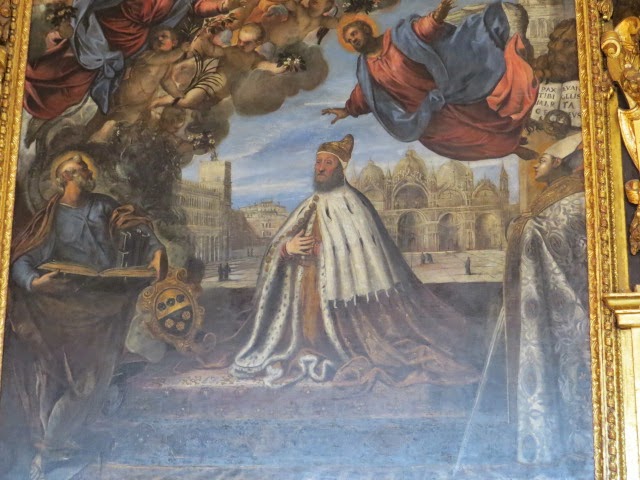


Various entities were created ad hoc and remained forever.  It was also decentralized and incorporated various checks and balances.  

The Palazzo structure at this site goes back to the 900s, but was continually modified and expanded.  What you see today is a reconstruction done in the 1570s and 1580s, after a bad fire.

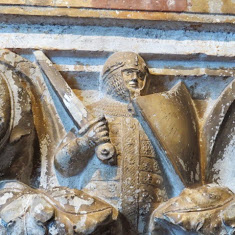
Some of the damaged stonework has been preserved.  This piece shows how the blue and gold color was once much more extensive:

Photo


The ornate courtyard with a St. Mark dome in the background:


The clock in the Senate Chamber had 24 hours and went counter-clockwise.  This is not a reversed image:
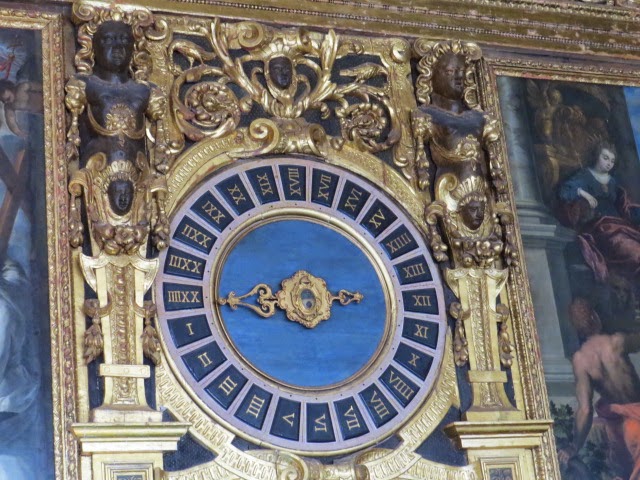


For longer proceedings, the Senators could watch the Zodiac go by:


Our camera could catch this small item (above the throne in the Grand Council room) from a good distance:


Bruce is so pleased with his camera.

Dinner at Le Café on San Stephano P.  Tagliatare and pizza.

Thursday, August 7, 2014

Still in Venice Aug 4-6


Did we say just how much we like Venice?  And we are a bit touristed out.  So we have been taking it easy, reading, resting, planning the next bits of the trip.  As a result, we have booked another two weeks here.  Wednesday afternoon, with the help of our new "host" we will move into another Venice apartment.


August 4, a Monday.  


Diversion:  Vaporetti
 
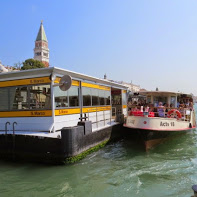
The public transportation system in Venice is basically made up of water buses, called vaperetti (singular, vaporetto).  Route 1 goes along the Grand Canal with a lot of stops; No. 2 makes fewer stops along the Grand Canal, so it’s a bit faster, and it will take you beyond, to Guidecca and the outside perimeter.  A stop looks like this:


3eAqU4VbeoLy_2_DfsymlhC2g9gSIYLLgOrarLSXyN8=s197-p-no


The system is:


Expensive. 7 euros, or about $10, for a 40-minute ticket.  If you’re here more than 2 days, you will probably do well with the 7-day ticket for 50 euros.  We will spend close to $600 on public transportation for the month were are here.  
 
Crowded, modelled upon the biblical ark.  But a trip on the Grand Canal is always a privilege, nonetheless.

Diversion:  The Academia Bridge:   Venice has 435 bridges, but only 4 cross the Grand Canal.  The Academia Bridge was designed by Eugenio Miozzi and opened in 1933.  It was expected to be a temporary bridge, but it was kept by popular demand.


IMG_0970.JPG

It is described as a wooden bridge and it looks like one.   We noticed, however, that the wood it rotting away in places and, from below, it looks like the wooden parts are not structurally required:


IMG_0971.JPG


The Naval Historical Museum is vast, on 5 floors, with no elevator.  Leslie mostly sat it out.


This museum is run by the Navy of Italy, so it includes Venetian, Hapsburg, and Neapolitan artifacts.


Model of the Doge’s last barge:


IMG_1024.JPG


One room had a collection of about 100 small, naive paintings, from the 17th century, that were adorning a church in Naples.  The donors had all survived perilous mishaps at sea:


IMG_1014.JPG


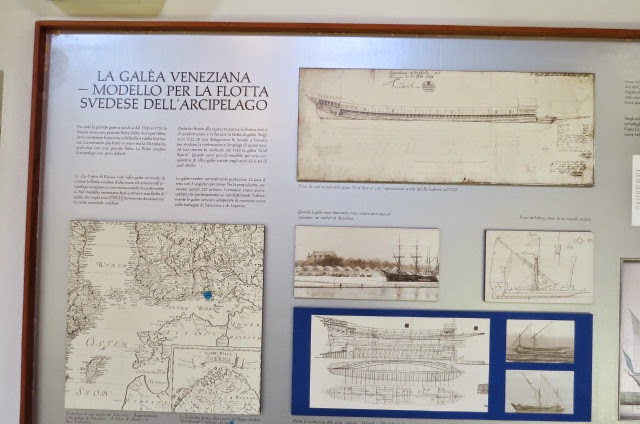
The highest floor had a “Swedish Room.”  Apparently, the Swedes were big customers of the Venice shipyards and Venetian officers served in the Swedish Navy.


IMG_1018.JPG


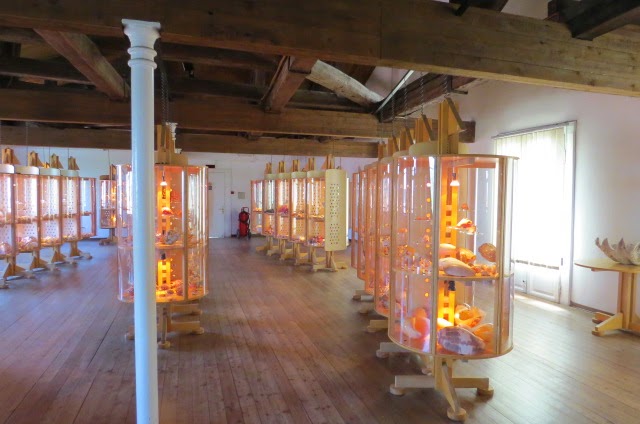
There was also an artistically displayed shell collection:


IMG_1020.JPG


Lunch take out.  Wine bought at the Punto Simply market, excellent.  A valdimezzo valpolicella ripasso superiore by Satori 2012.  About 9 euros.   We like it a lot, so we make this note and look it up on the net.  The Sartori site says its a blend:  55% Corvina,  25% Corvinone,  15% Rondinella,  and 5% Croatina.


A note on directions:  Addresses in Venice are probably only good for postmen and, maybe, computer mapping. Venice is divided into six districts. The addresses in each district are simply numbered sequentially.  We are at 45 Santa Croce, calle della Madonna.  Thus, to give directions, you find a landmark and direct from there. When we needed a mailing tube, a very nice salesperson made us directions, starting at the Hard Rock Cafe, over the bridge, right at the puma store, etc.  We found it with little trouble.  Our new landlord is going to help us move.  We finally were able to locate a pastry store (excellent, we will miss the bread) where we can meet.


Tues, August 5th.


We visited three churches north and east of the Rialto Bridge.


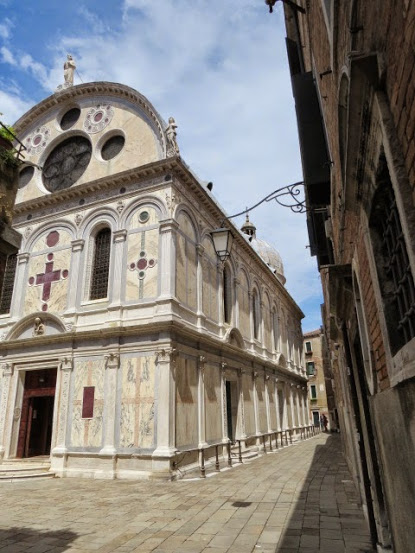
The first, Santa Maria dei Miracoli, was the most interesting.  In the 15th century, a painting of the madonna, owned by a successful merchant, was the source of many miracles.  The Council ordered the merchant to build a suitable church to house the miraculous work.  The result is a small, uncluttered building (1480s) using different marbles and other materials to great advantage.  It is always described as a “jewel box.”


IMG_1034.JPG


IMG_1035.JPG


IMG_1036.JPG


Next, Giovanni e Paolo, which is attached to the Civic Hospital.  The Hospital is on the left:


IMG_1044.JPG


Inside, the church is very large.  It uses many gothic elements, but they are not combined and exploited to produce the soaring awe of its French predecessors:


IMG_1047.JPG


The Italians never “got” gothic.  Vasari, in fact, was the author of the term “gothic” to disparage it as barbarian.  The only cathedral overtly seeking a gothic presentation is in Milan, and it is impaired by excessive and unsuitable ornamentation:


876MilanoDuomo.JPG


Here is a chapel at Santa Maria Formosa.  The gothic format is overwhelmed (but, admittedly, not at all a bad result):


IMG_1048.JPG


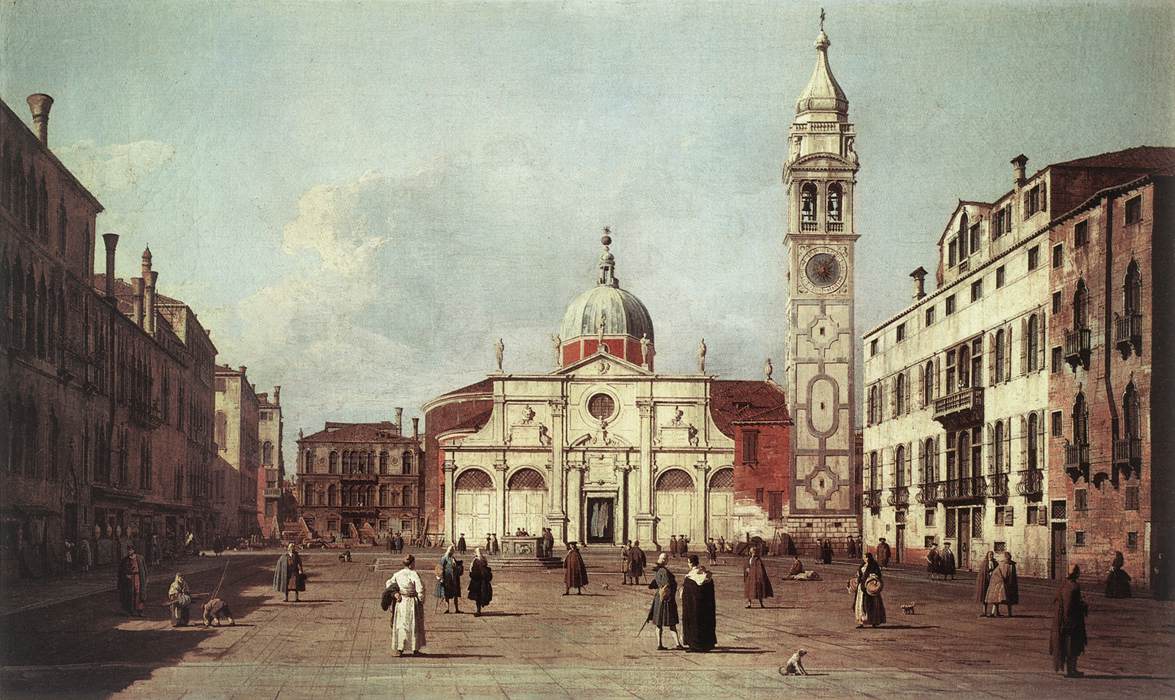
Santa Maria Formosa, our last church today, is a smaller structure on a large piazza.  Our camera battery was fully depleted.  So this is Caneletto’s take, which is pretty close to what you see today:


campo-santa-maria-formosa.jpg


Dinner at da Silvio.  Leslie had fegato veneziano (liver and onions with polenta); Bruce had veal scalopine pizzaiola.  The mosquitos ate both of us.
Wed., August 6.  Moving day.
It took a while to pack up and extract our effects.  For lunch, we took the vaporetto to the Rialto Mercato stop. The market is quite large and unexciting.  We had lunch at a random tratorria.  Leslie had gnocchi and Bryce had a large salad.  On the way back, Leslie was ill, but she recovered before our trek across the canal to our new place in the San Marco district. 

We started to look for lodging quite late.  that left us with a small online selection of apartments meeting our need for a central location, wifi, and few stairs.  We were greeted with rodent pellets just outside the door.  We've seen enough of that in Florida and D.C. not to get freaked.

What we have is expensive, large, old, smelly and quirky.  The building is perhaps 250 years old.  The host thinks 15th century.  Hard to tell.  The owner is a remarried widow and the couple spends their time in Geneva with trips to Africa.  She probably lived here 50 years.  As you would expect, nothing is bland and much is highly personal.

Photo


Photo

Photo

We have sequestered several taxicab-type paper odor trees.  The A/C works well.  The water temp is variable, but there is adequate hot water.  The washer worked.  And the neighborhood has compensations.  More next post.

Sunday, August 3, 2014

Venice August 1-3.

Friday, Aug 1.  A day off.  Dinner at Dolfin just a few meters down the street (good lasagne and pasta with bacon and tomato).


Sat. August 2.  


We were back at the San Marco Basilica this morning, spending one hour at the top of the loggia, a/k/a the Basilica Museum.  There are wonderful architectural drawings from the 18th and 19th centuries and views from the loggia.  Also, the lights were on so the mosaics could be more easily appreciated.  But, it’s up about 50 steep, high-rise, uneven, medieval steps.  Another thing we will not be able to do again.  We complied with the no-photos edict.  We may have been in a minority on that.  We acted very Venetian and returned to the apartment for lunch and a nap.


We spent the late afternoon on the island of S. Giorgio Maggiore.  There’s a huge Palladio church built on land granted by Doge Tribuno Memmo to the Benedictines in 892.


gio


The bell tower has a lift and spectacular views.


IMG_0939.JPG


IMG_0938.JPG


Our new camera is a compact Canon with a fixed 50x zoom lens.  Here’s a cruise ship a few km away.  1/1000 sec exposure.  Bright light helps.


IMG_0934.JPG


These behemoths pass right in front of San Marco.  It may be wonderful to look out over the city from the top deck.  But we doubt that the Venetians have any enjoyment seeing them in their lagoon.  Not only are they ugly and jarringly industrial, they tower above the city.  Some locals contend that they do incalculable ecological damage.  They are likely right.


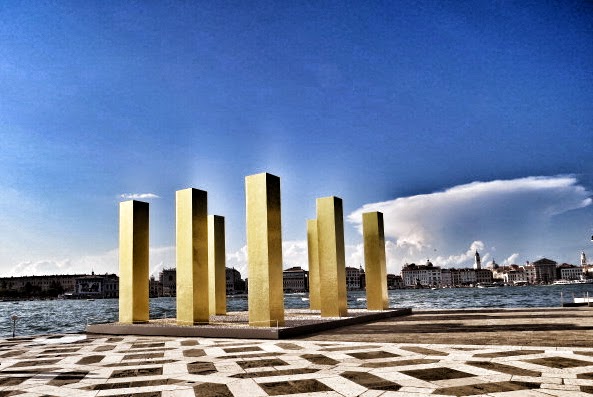
The Biennale spawns exhibitions all over Venice.  These were on S Giorgio.


The Sky over Nine Columns by Heinz Mack


IMG_0944.JPG


The glass work by  I Santillana, Laura


i2pzWfdmvqcQxGU6tBf05wofYcZ5L3TE8bI-sX7pxU4=s197-p-no


Alessandro


IMG_0948.JPG


Japanese artist Hiroshi Sugimoto offered the installation Glass Tea House Mondrian.


IMG_0957.JPG


We did not figure out the Mondrian piece.


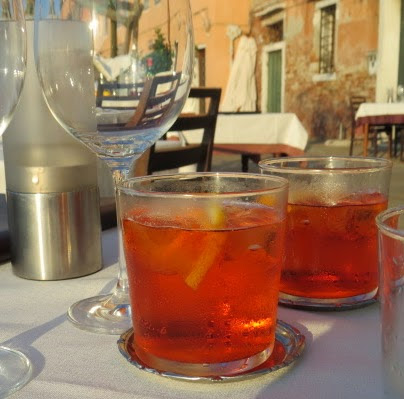
Splurge birthday dinner along the water on the Giudecca at Figlio della Stella.  We started with aperol spritzes:


MjdJ8xVisHg8LFB-UzEP0_3czbcDmBOADbtO_NGUdbo=w404-h399-no


Despite their toxic appearance (the orange is way brighter in real life), we have become fond of this low-alcohol drink.   I have not had the chance to make one yet, but my starting recipe will be:


3 parts Prosecco
2 parts aperol
splash seltzer
slice orange


Leslie ate a baked lamb dish with bacon and cheese.   Interesting; very strong flavor (mutton?).   Bruce had the mixed fried seafood and veggie plate.  Good, but not close to the same dish served to him in Padua.  Shared a brandy mousse for dessert.  Shrug.


A long trip back with vaporetto transfer required.  Late return.


Sunday, August 3


We returned to the Accademia, since our previous visit was incomplete.   There are two rooms of monumental works that are nominally addressed to some miracle, but are
really decorative panels that show off Venetian pomp and artistic virtuosity.  Here is Giovanni  Mansueti’s “Miraculous Healing of the Daughter of Benvegnudo of San Polo”:


Then we walked to the Palazzo Cini.  Cini was a very wealthy industrialist.   His small collection of old master works is now on public display.


The lighting is new, high frequency LED spots.  Fine for the visitor, but the reflections make photos very difficult.


Cini’s Botticelli:


Portrait of Two Friends by Portomo:


Mazzolino’s Circumcision of Christ, a riot of color and precision about 12” wide:


Jesus always looks so joyous at his circumcision.


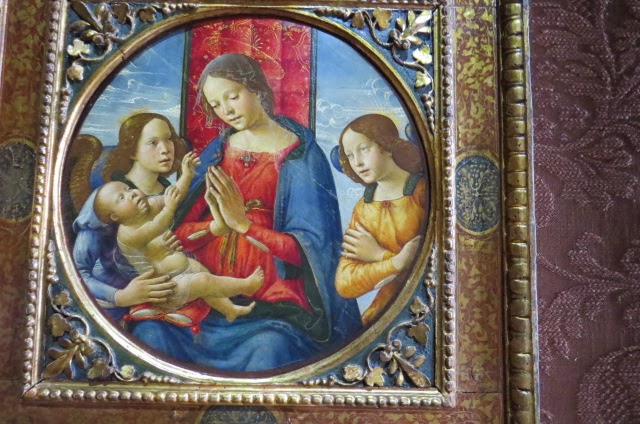
There was a beautiful tondo attributed to Ghirlandaio and shop:


ghi2


Bruce was not satisfied with that photo.  We found this one at Wikipedia, where it is attributed to Bastiano Mainardi, Ghirlandaio’s brother-in-law:  


ghir.jpg
These are definitely the same work. See the crease line running through Mary.   Can the new lighting at the Cini explain the differences in the color?

We turned the other direction for dinner tonight.  Lovely restaurant with less than mediocre food - pasta bolognese, gorgonzola ravioli.

Friday, August 1, 2014

Venice July 30 - 31


Wednesday, July 30


Lazy day.  Lunch at  da Silvio (gnocchi al ragu and gnocchi with salmon sauce).

We went for a walk.  We stopped at the church of San Moise.  This is a very old (8th century) church which serves as the parish church for San Marco.  The tourists tend to make everyday worship at San Marco difficult.

We were surprised to find Moses a saint.  Apparently, the Venetians, like the Byzantines that had such impact on their history, canonize Old Testament prophets.  Moses does not appear on the Catholic saint site, but he is on the Greek Orthodox list.  The altarpiece:


We also found this unusual Renaissance staircase:


We were guided here by the 2013 Rick Steves Venice guide, which our apartment "host" loaned to us.  He tells us that it is, unexpectedly, the best guidebook available on Venice for identifying sites.
 
Thurs.  July 31  

This year is the Biennale of Architecture. It is curated Rem Koolhaas, who was assisted by students at Harvard's Graduate School of Design.  The Biennale is titled "Fundamentals". 

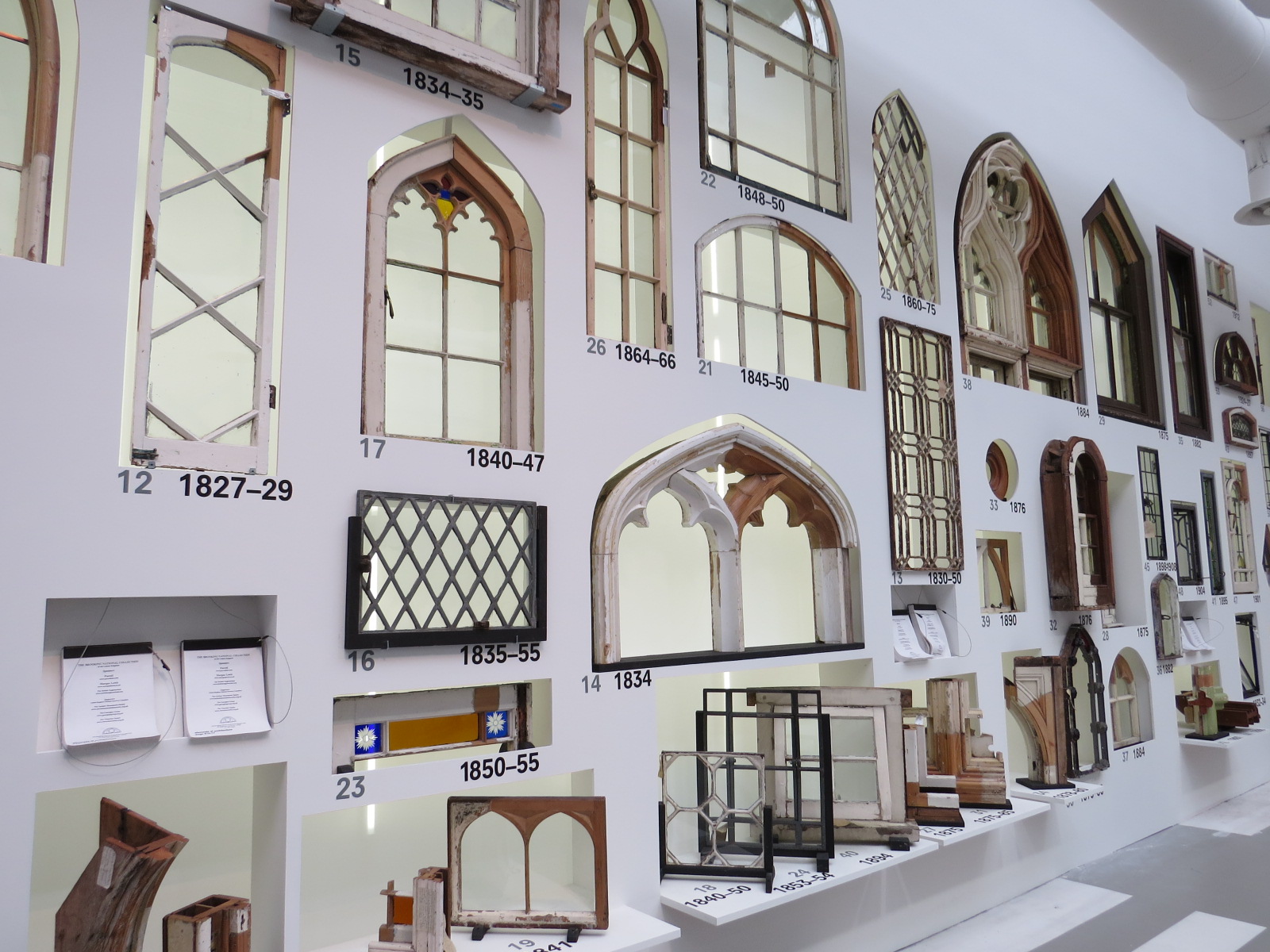
The main exhibit is "Elements of Architecture".  Elements are ceilings, windows, facades, floors, etc.  The theme of the exhibit is the history of modernization from 1914 to 2014.  A film (small snippets of old movies) was shown showing the role of architectural elements in films- walking down a corridor, scaling a facade, gazing from a balcony, and many more.  We recognized few of the clips, but it was entertaining.  Cool elements include a floor that keeps track of where you are and if you fall; LED façade; and walls of light-transmitting concrete.
We have a few images to share:

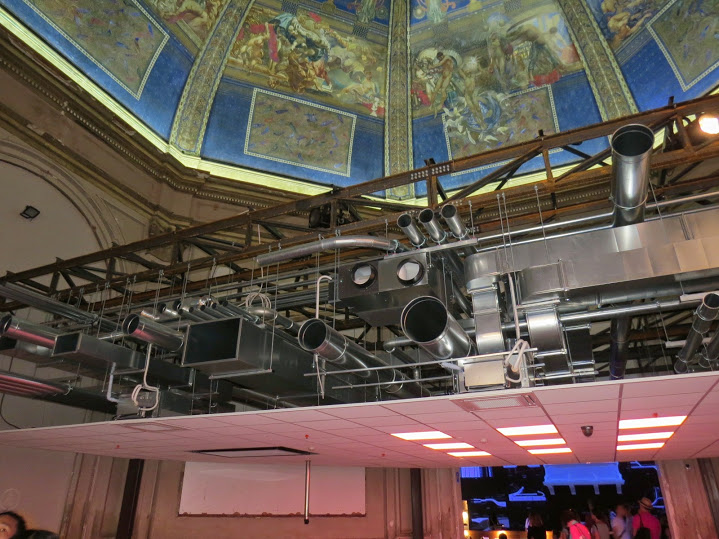
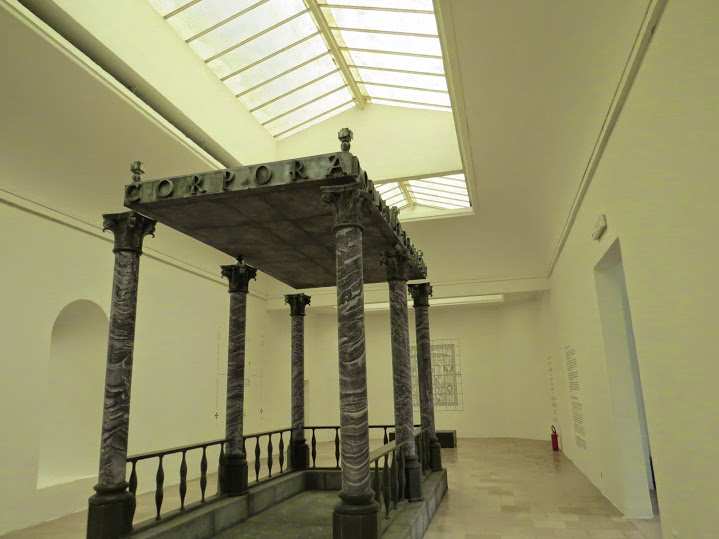
Ceiling


This also demonstrates the fun of using a preexisting building.

Window


IMG_0901.JPG


Roof


There are also some 66 country pavilions.  


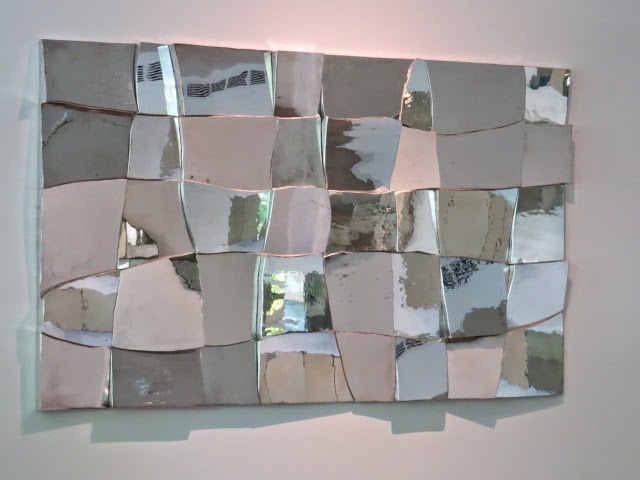
The Russian pavilion featured some ideas for emergency construction, including these cemented rubble panels:


IMG_0876.JPG:


"The Polish Pavilion installation introduces an architecturally and mentally impossible object."


Other items on the grounds
 
Cement sculpture near entrance to grounds:


LeCorbusier’s Maison Dom-Ino:


IMG_0897.JPG

This was conceived by Corbusier in 1914 as a prototype for European housing.

Dinner at Trattoria Dona Onesta.  Bruce had  pork chop, salad, and chocolate cake.  Leslie had veal in Marsala sauce and panna cotta with caramel.